Prop
Why I Am Now Trading With Apex
Apex Trader Funding recently released an update to their program rules and account guidelines, introducing an EOD drawdown account structure. This change places the firm among the prop firms that fit within the type of accounts I choose to trade. Here I break down why the update matters and how the structure of these accounts shapes the way I approach them.
What Matters With the Apex Update
Apex was previously a prop firm that I would avoid due to their extended rules and intraday drawdown accounts. While the ability to scale was always there with the large max allocation of 20 PA accounts, the route to truly leverage it presented too many obstacles for my trading style. As someone who is highly focused on the process of their system, the one thing I look for in a prop firm are guidelines that allow me to execute without significant restrictions on my actions. Your model is what makes the money. You should not allow prop firms to step in the way of that.
This update established an improved version of Apex that now aligns with what I look for. Below are the main adjustments that you should care about.
EOD drawdown account options
Removal of monthly billing for evaluation accounts (30 days to pass)
No minimum required trading days to pass evaluation stage
Scaling on funded daily drawdown and maximum contracts
Only able to pay out on profit above the buffer
Removed MAE and risk to reward rules
Accounts last a maximum of 6 payout cycles
New EOD Drawdown Account Guidelines
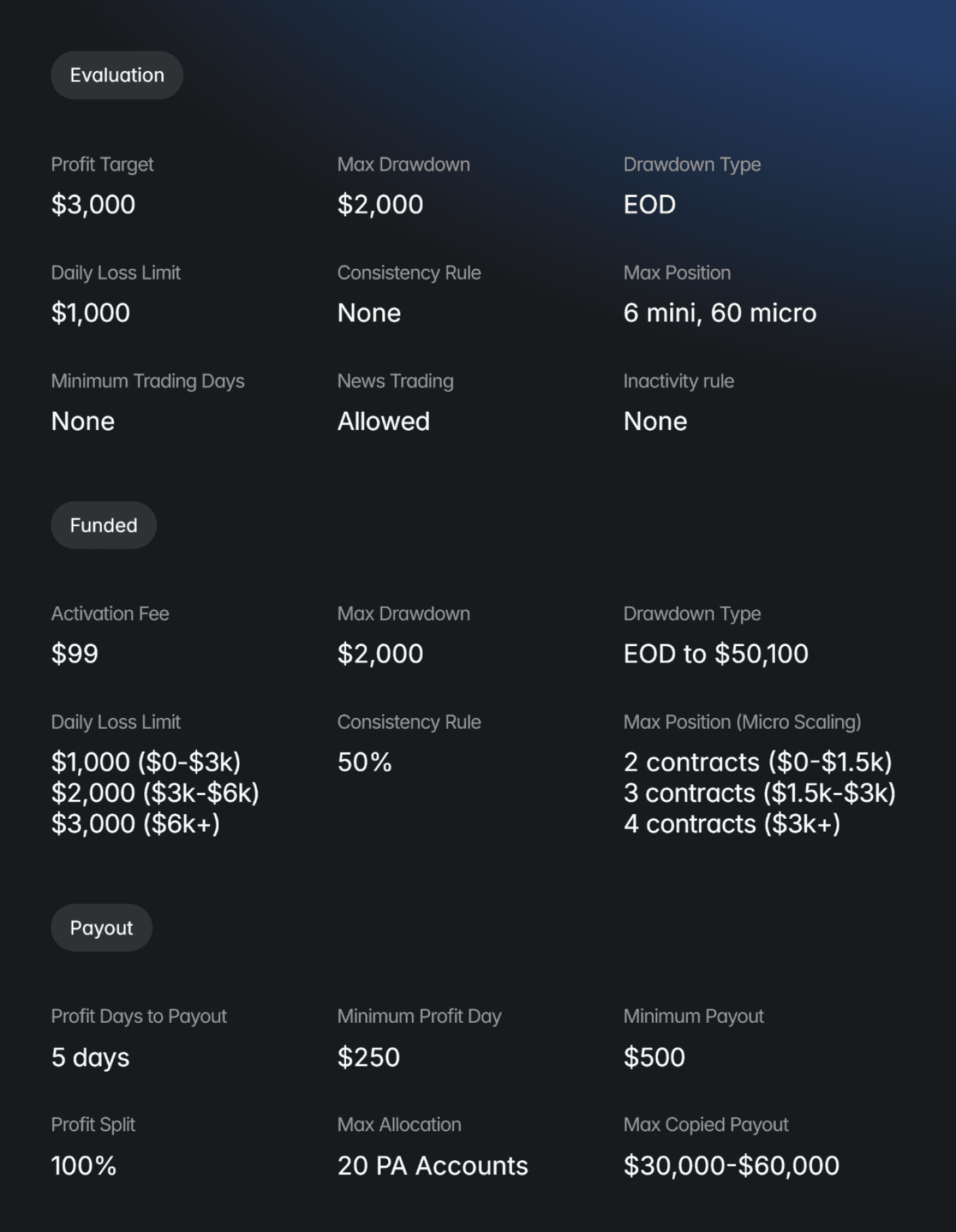
The EOD drawdown accounts are the ones I am trading with as they avoid intraday trailing drawdown altogether. Specifically, the $50,000 account size, as it provides the most drawdown and upside per dollar spent. Anything above or below that account size falls outside of that balance.
My Approach With the Accounts
With the updated account guidelines, there is no specific rule that raises caution relative to my normal approach. That is always the baseline when I evaluate any prop firm. These accounts do have a certain dynamic, and I approach them with that in mind.
Evaluations are never something that I aim to spend an extended amount of time on since there is no payout potential during that stage. This is emphasized even more when trading with Apex, as they frequently offer large discounts on the evaluation fee. The upfront cost to access the accounts is relatively low, while the real cost comes once the accounts are activated.
As an example, if you are using the $50,000 EOD accounts at Apex and copy trading 10 at once, the cost to start them during an 85 percent sale is $300. Once those accounts are passed, the total cost to activate them is an additional $990. Unlike other popular firms I trade with, such as Lucid or Tradeify, which typically charge a higher upfront fee with no activation cost, the true cost structure with Apex occurs at the activation stage.
Understanding this slightly changes how I approach the evaluation phase. Because less capital is allocated upfront, there is more flexibility to take slightly more risk in order to move through the evaluation stage efficiently rather than spending unnecessary time there. However, this does not mean irresponsibly risking or gambling the accounts. That is exactly what the firm hopes traders will do, as the low upfront cost can make people careless during evaluations while they burn through cash without realizing it. My increased risk and positioning only occur within reason and remain inside a system I already know works.
Once the evaluations are passed and the accounts are activated, that is when the real cost is allocated and trading begins with payout potential. At that point my risk and execution return fully to the standard structure of my system. With accounts being copied, the focus shifts to maintaining stability above the minimum balance required for payouts. As payout limits increase after consecutive withdrawals, keeping accounts consistently above that threshold through multiple payout cycles becomes more valuable than pushing aggressively and risking resets.
Prop
Learn
Explore mentorship with

AM and

TTrades
The standard of trading guidance

Prop
Learn
Get funded with the prop
firms I trade with
Use code AM for the best discount



What Matters With the Apex Update
Apex was previously a prop firm that I would avoid due to their extended rules and intraday drawdown accounts. While the ability to scale was always there with the large max allocation of 20 PA accounts, the route to truly leverage it presented too many obstacles for my trading style. As someone who is highly focused on the process of their system, the one thing I look for in a prop firm are guidelines that allow me to execute without significant restrictions on my actions. Your model is what makes the money. You should not allow prop firms to step in the way of that.
This update established an improved version of Apex that now aligns with what I look for. Below are the main adjustments that you should care about.
EOD drawdown account options
Removal of monthly billing for evaluation accounts (30 days to pass)
No minimum required trading days to pass evaluation stage
Scaling on funded daily drawdown and maximum contracts
Only able to pay out on profit above the buffer
Removed MAE and risk to reward rules
Accounts last a maximum of 6 payout cycles
New EOD Drawdown Account Guidelines
The EOD drawdown accounts are the ones I am trading with as they avoid intraday trailing drawdown altogether. Specifically, the $50,000 account size, as it provides the most drawdown and upside per dollar spent. Anything above or below that account size falls outside of that balance.
My Approach With the Accounts
With the updated account guidelines, there is no specific rule that raises caution relative to my normal approach. That is always the baseline when I evaluate any prop firm. These accounts do have a certain dynamic, and I approach them with that in mind.
Evaluations are never something that I aim to spend an extended amount of time on since there is no payout potential during that stage. This is emphasized even more when trading with Apex, as they frequently offer large discounts on the evaluation fee. The upfront cost to access the accounts is relatively low, while the real cost comes once the accounts are activated.
As an example, if you are using the $50,000 EOD accounts at Apex and copy trading 10 at once, the cost to start them during an 85 percent sale is $300. Once those accounts are passed, the total cost to activate them is an additional $990. Unlike other popular firms I trade with, such as Lucid or Tradeify, which typically charge a higher upfront fee with no activation cost, the true cost structure with Apex occurs at the activation stage.
Understanding this slightly changes how I approach the evaluation phase. Because less capital is allocated upfront, there is more flexibility to take slightly more risk in order to move through the evaluation stage efficiently rather than spending unnecessary time there. However, this does not mean irresponsibly risking or gambling the accounts. That is exactly what the firm hopes traders will do, as the low upfront cost can make people careless during evaluations while they burn through cash without realizing it. My increased risk and positioning only occur within reason and remain inside a system I already know works.
Once the evaluations are passed and the accounts are activated, that is when the real cost is allocated and trading begins with payout potential. At that point my risk and execution return fully to the standard structure of my system. With accounts being copied, the focus shifts to maintaining stability above the minimum balance required for payouts. As payout limits increase after consecutive withdrawals, keeping accounts consistently above that threshold through multiple payout cycles becomes more valuable than pushing aggressively and risking resets.
What Matters With the Apex Update
Apex was previously a prop firm that I would avoid due to their extended rules and intraday drawdown accounts. While the ability to scale was always there with the large max allocation of 20 PA accounts, the route to truly leverage it presented too many obstacles for my trading style. As someone who is highly focused on the process of their system, the one thing I look for in a prop firm are guidelines that allow me to execute without significant restrictions on my actions. Your model is what makes the money. You should not allow prop firms to step in the way of that.
This update established an improved version of Apex that now aligns with what I look for. Below are the main adjustments that you should care about.
EOD drawdown account options
Removal of monthly billing for evaluation accounts (30 days to pass)
No minimum required trading days to pass evaluation stage
Scaling on funded daily drawdown and maximum contracts
Only able to pay out on profit above the buffer
Removed MAE and risk to reward rules
Accounts last a maximum of 6 payout cycles
New EOD Drawdown Account Guidelines
The EOD drawdown accounts are the ones I am trading with as they avoid intraday trailing drawdown altogether. Specifically, the $50,000 account size, as it provides the most drawdown and upside per dollar spent. Anything above or below that account size falls outside of that balance.
My Approach With the Accounts
With the updated account guidelines, there is no specific rule that raises caution relative to my normal approach. That is always the baseline when I evaluate any prop firm. These accounts do have a certain dynamic, and I approach them with that in mind.
Evaluations are never something that I aim to spend an extended amount of time on since there is no payout potential during that stage. This is emphasized even more when trading with Apex, as they frequently offer large discounts on the evaluation fee. The upfront cost to access the accounts is relatively low, while the real cost comes once the accounts are activated.
As an example, if you are using the $50,000 EOD accounts at Apex and copy trading 10 at once, the cost to start them during an 85 percent sale is $300. Once those accounts are passed, the total cost to activate them is an additional $990. Unlike other popular firms I trade with, such as Lucid or Tradeify, which typically charge a higher upfront fee with no activation cost, the true cost structure with Apex occurs at the activation stage.
Understanding this slightly changes how I approach the evaluation phase. Because less capital is allocated upfront, there is more flexibility to take slightly more risk in order to move through the evaluation stage efficiently rather than spending unnecessary time there. However, this does not mean irresponsibly risking or gambling the accounts. That is exactly what the firm hopes traders will do, as the low upfront cost can make people careless during evaluations while they burn through cash without realizing it. My increased risk and positioning only occur within reason and remain inside a system I already know works.
Once the evaluations are passed and the accounts are activated, that is when the real cost is allocated and trading begins with payout potential. At that point my risk and execution return fully to the standard structure of my system. With accounts being copied, the focus shifts to maintaining stability above the minimum balance required for payouts. As payout limits increase after consecutive withdrawals, keeping accounts consistently above that threshold through multiple payout cycles becomes more valuable than pushing aggressively and risking resets.


Prop
Learn
Get funded with the prop firms I trade with
Use code AM for the best discount



Prop
Learn
Explore mentorship with
AM and
TTrades

Prop
Learn
Get funded with the prop firms I trade with
Use code AM for the best discount
Prop
Learn
Explore mentorship with
AM and
TTrades
Prop
Learn
Explore mentorship with
AM and
TTrades
The standard of trading guidance
Prop
Learn
Get funded with the prop
firms I trade with
Use code AM for the best discount
Prop
Learn
Explore mentorship with
AM and
TTrades
The standard of trading guidance
Prop
Learn
Get funded with the prop
firms I trade with
Use code AM for the best discount

Why I Am Now Trading With Apex
Continue Learning.



© 2026 AM Trades. All Rights Reserved.
© 2026 AM Trades. All Rights Reserved.
© 2026 AM Trades. All Rights Reserved.