



How I'd Become Profitable Trading Again (If I Had to Start Over)
Process
How I'd Become Profitable Trading Again (If I Had to Start Over)
Most traders fail to make progress not because they lack knowledge, but because they lack direction. This article covers the three steps that build a real foundation in trading: committing to one system, reviewing every decision through a structured feedback loop, and focusing on the process that actually produces consistent results.
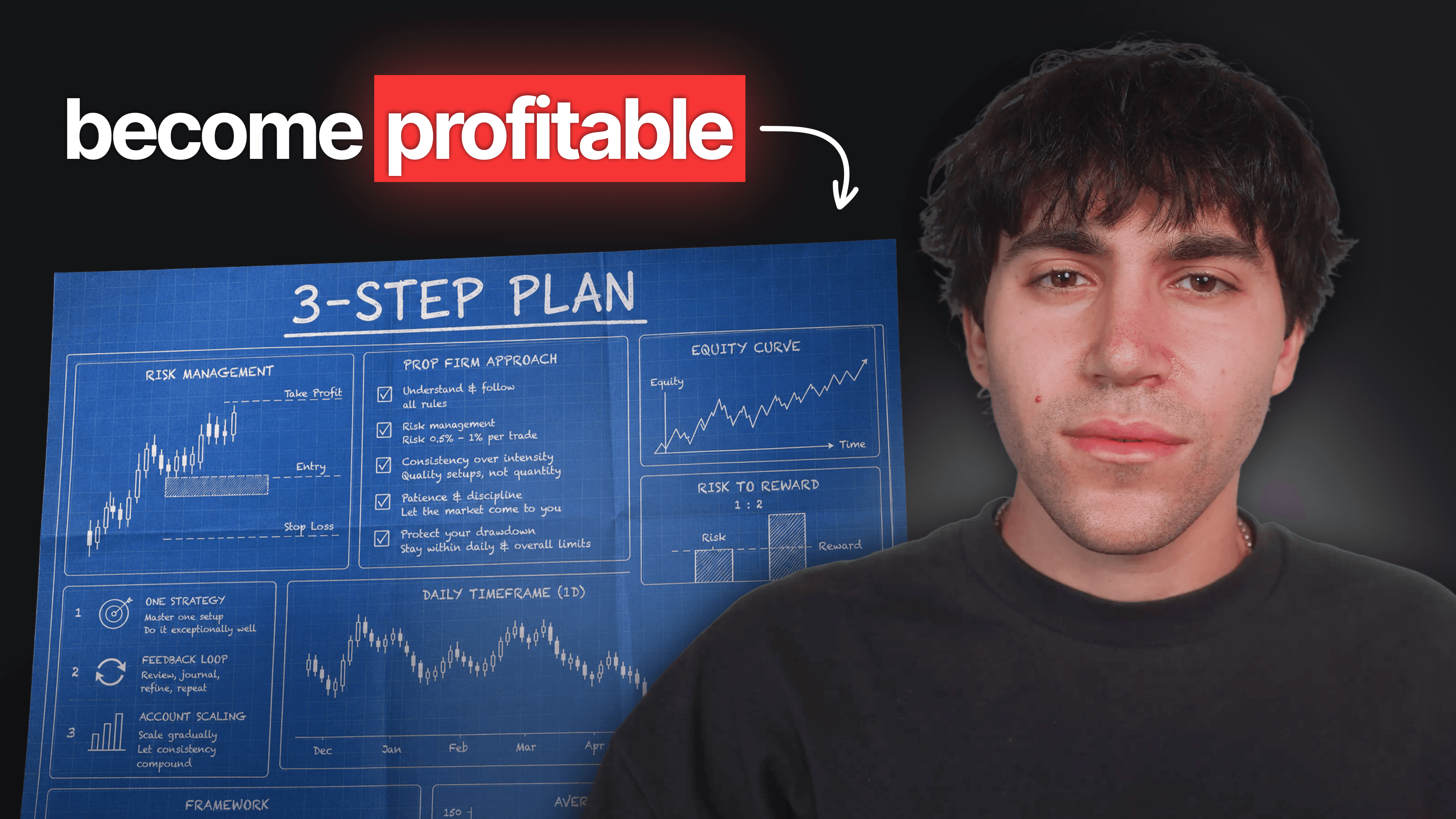
Three Steps I Would Follow to Get Back to Profitability from Day One
Over six years ago, I started trading with ambition but no direction. That combination led to years of wasted time, no real progress, and lack of understanding for what I was actually missing. The path to consistency only became clear after going through repeated trial and error to figure out what actually mattered.
This is that process laid out directly. Three steps that, if I could go back with what I know know, would lead me to profitability in half the time it originally took me.
Step One: Commit to One System
The most common reason traders stall early is not a lack of knowledge. It is too much of it applied without any real depth.
For the first two years of my trading, I cycled through strategy after strategy. Support and resistance, trend lines, supply and demand, volume and order flow. Every time losses accumulated or the market felt unclear, the instinct was to find something new rather than refine what I already had. I was always trying to escape that discomfort of not knowing. That cycle repeated itself long enough to cost significant time and money before I recognized what was actually happening.
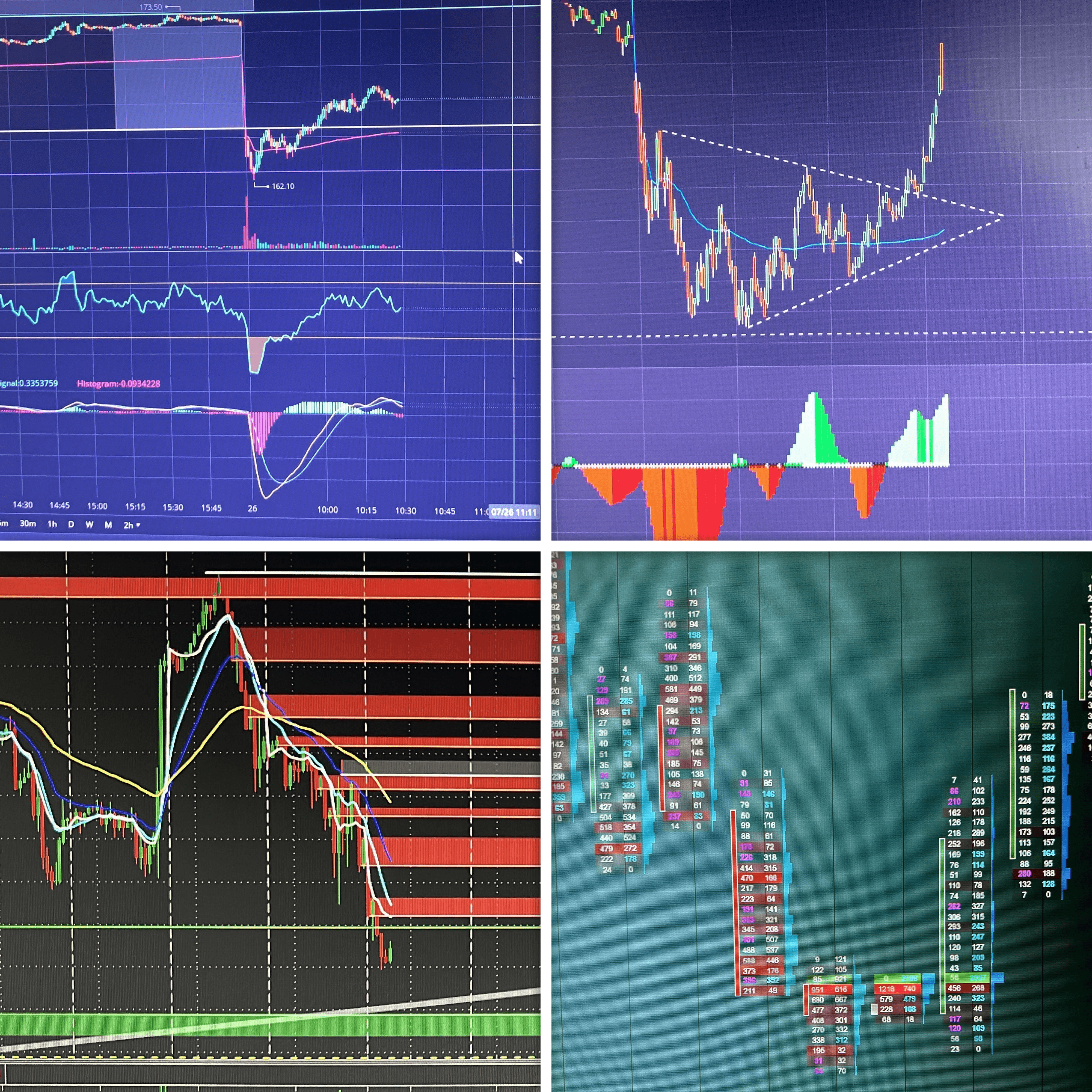
The moment that changed was when I found what I actually wanted to trade and committed to it without shifting away. For the past five years, everything I trade and everything I teach has operated under one system. The repetition that comes from that level of commitment is what builds real understanding through experience.
The system itself is straightforward. On the daily chart, relevant swings mark the extremes of the current range. A reaction at one of those levels establishes the framework and sets a directional expectation for the daily candle. Before executing, a daily profile must align to confirm that the candle is developing in a way that supports the expectation. If it does, an entry is considered in the continuation. If it does not, the day is passed entirely.
Those are the four steps to the model. One timeframe for bias, one layer of confirmation, one entry type, defined trade management. Nothing outside of it is relevant once you have experience and trust in it.
The point is not that this specific system is the only valid one. The point is that depth in one approach will always produce better results than baseline knowledge across many. Knowing less and knowing it extremely well leads to clarity in execution that no amount of accumulated concepts can replicate. Find the system that fits the style you are working toward, commit to it, and focus only on refining it over time.
Everything that follows depends on this foundation being in place first.
Step Two: Review Every Decision, the Right Way
Experience in the market only compounds when there is a structured process to extract lessons from it. Without that, the same mistakes repeat indefinitely and there is no mechanism to improve.
The trading day for an average trader looks like this: no defined plan going in, reactive decisions during the session, and moving on to the next day without reviewing anything. The effort feels real because the screen time is real. But without a feedback loop, nothing actually changes. Emotions stay unaddressed, bad habits reinforce themselves, and the same issues continue to surface.
The process to follow is plan, execute, review. Each stage has a specific role.
The plan is set before the session begins. This is where you define exactly what the market must do to provide a valid opportunity. You are not predicting. You are stating the conditions under which you will participate. If those conditions are met, a trade is executed under the model. If they are not, the day is over. There is no middle ground.
A real example of how this works: entering a session where two correlated pairs, NQ and YM, were showing opposing daily frameworks. Rather than forcing a trade on either in hopes for one to play out, the plan was to wait for the open and observe which side validated its framework.
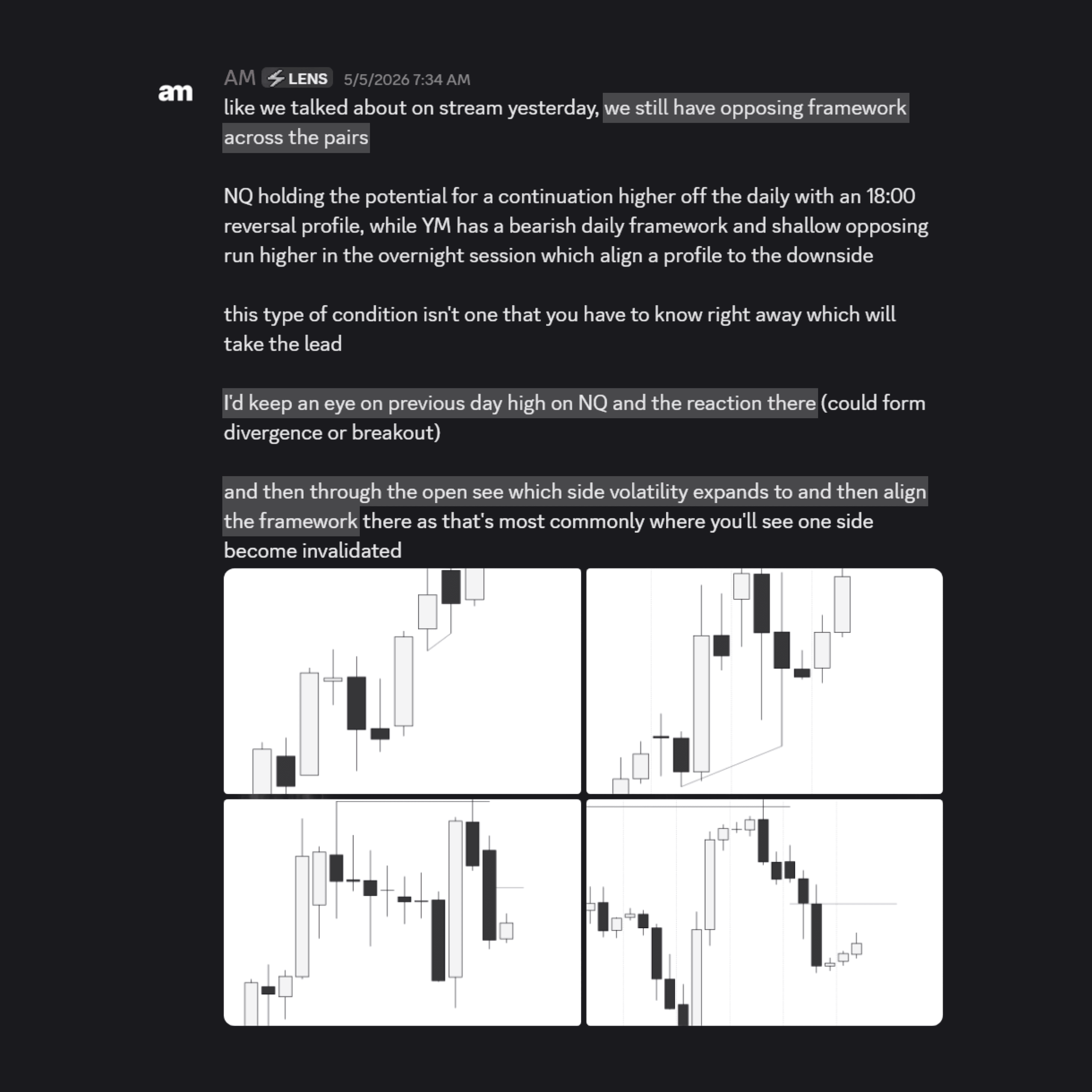
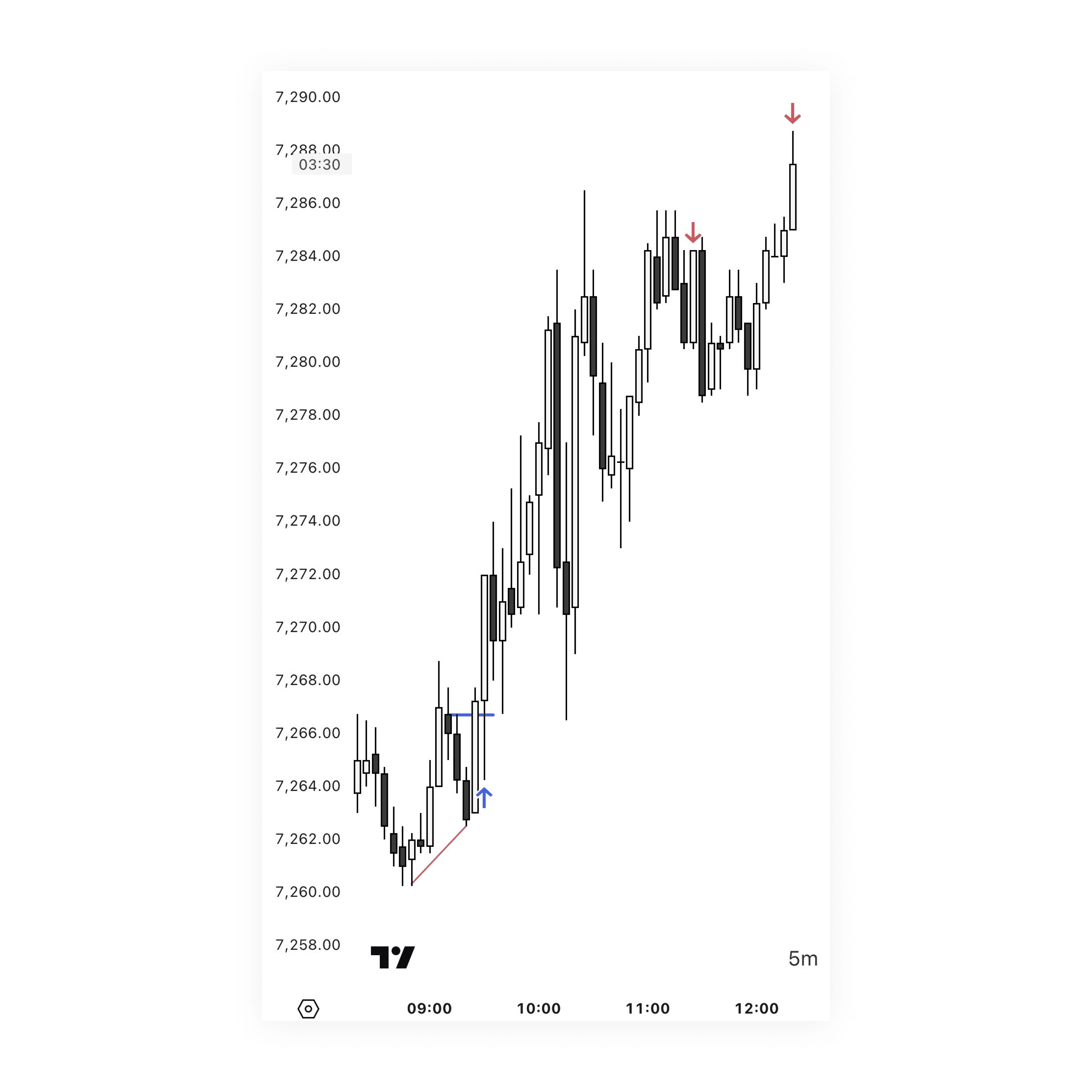
NQ showed a breakout through the previous day high while YM never confirmed its bearish framework. That immediately narrowed focus to NQ as the leading pair, and an entry was taken as the continuation aligned. The plan removed every reactive decision before the session even started.
After the session closes, every decision made that day goes under review. This applies whether a trade was taken or not.
For winning trades, the first question is whether you would take that trade again without knowing the outcome was a win. Not every winning trade is positive. A win that came from breaking your rules carries no edge. If the trade was valid, the review focuses on what could have been improved in execution and management. If it was not valid, the review focuses on where you deviated from the plan and why.
For losing trades, the same logic applies. Not every losing trade is negative. A loss taken on a valid setup, managed correctly, with disciplined exit is a good loss. The review identifies what was done well despite the outcome and whether emotions remained controlled after the loss was realized. If the loss came from a setup that should not have been taken, the review addresses where the deviation happened and what warning signs were present beforehand.
For days with no trades, the review asks whether a valid setup was missed. Passing on a day with no valid opportunity is a positive decision. Missing a valid setup is not. The difference between these two outcomes tells you exactly where your understanding of the model needs to improve.
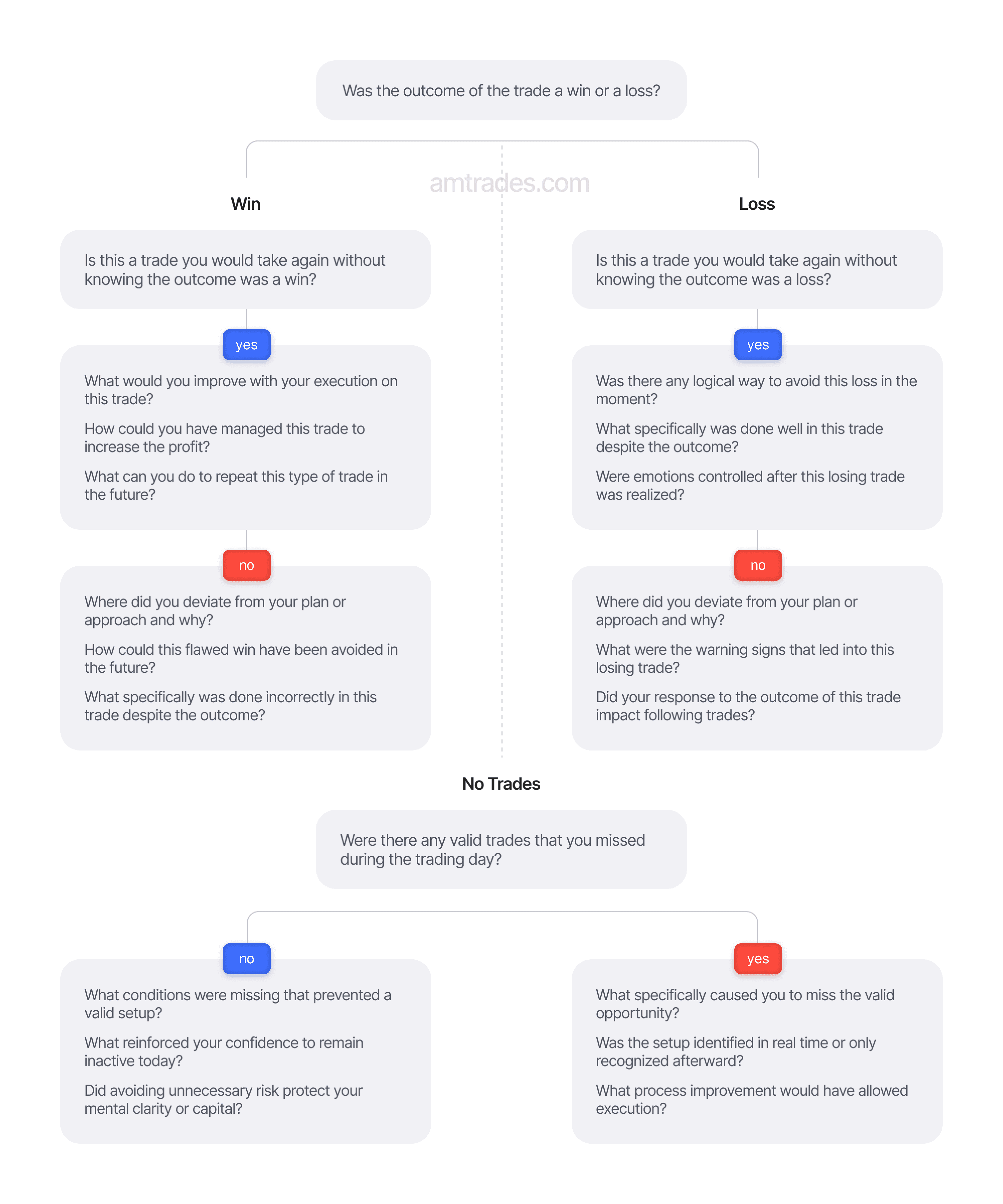
Going through this consistently creates a compounding effect. Every decision, good or bad, becomes a data point that makes you a more capable trader the following day. Your only job is to actually apply what you learn.
Step Three: Stop Trying to Make Money
This is the step that sounds counterintuitive but is the one that makes everything else work.
When I started trading, I funded a live account before I had a system, before I understood risk management, before I could even place and close an order correctly. I made over four thousand dollars in a single day early on and thought I had it figured out. Then I lost it all back over the following weeks and months. The drive for the outcome was so strong that it overrode every rational decision. That pattern continued until I accepted that the only sustainable path was process first and outcome as a byproduct.
The money in trading follows the process. And that is not a motivational framing. Traders who focus on the outcome take trades their system does not support, manage positions based on what they want to happen rather than what the model says, and abandon systems after normal periods of drawdown. Traders who focus on the process build the consistency that actually generates sustainable results over time.
The practical application of this is in how prop firms can be used, particularly in the earlier stages of building experience. The 50k Flex plan from Lucid Trading is an account that works well to structure this approach around.
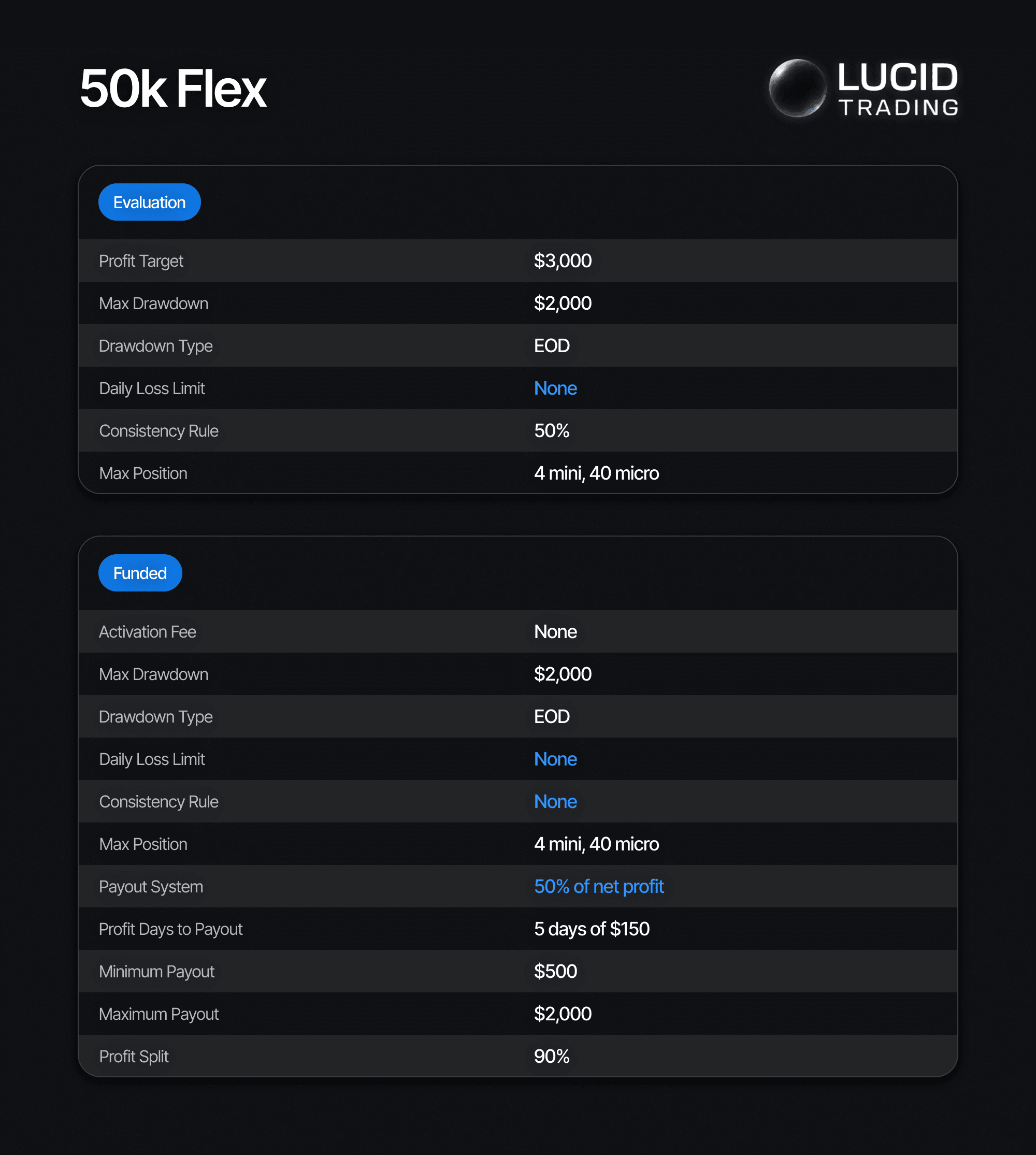
Rather than funding a personal live account and placing direct financial pressure on every trade, you can use an evaluation account to gain experience under the model with defined risk limited to the fee itself. The intent with a first evaluation is not to extract the maximum payout. It is to build a real equity curve under your system, learn how the rules interact with your trading, and develop the discipline of following the process in a live environment.
Once that funded account is reached, the goal is the minimum payout. That payout gets reallocated into the next evaluation, this time with slightly increased risk to reflect how you will trade on a recurring basis. The pattern continues from there, gradually scaling funded accounts and eventually copying trades across them at low risk to multiply output without multiplying pressure.
The structure allows scaling without the constant weight of outcome dependence. Low risk per trade, defined rules, no direct capital at stake beyond the initial fee. That environment makes it significantly easier to focus on the only thing that actually builds a profitable trader, which is following the process correctly every single day.
The Path Forward
These three steps work together. Commitment to one system gives you something to actually build on. A structured review process creates the feedback loop that turns experience into improvement. And removing the outcome focus allows the first two steps to function the way they are supposed to.
There is no shortcut between starting and being consistent. But there is a clear path, and these steps are it.
Prop
Learn
Explore mentorship with

AM and

TTrades
The standard of trading guidance
Prop
Learn
Get funded with the prop
firms I trade with
Use code AM for the best discount
Watch on YouTube
Three Steps I Would Follow to Get Back to Profitability from Day One
Over six years ago, I started trading with ambition but no direction. That combination led to years of wasted time, no real progress, and lack of understanding for what I was actually missing. The path to consistency only became clear after going through repeated trial and error to figure out what actually mattered.
This is that process laid out directly. Three steps that, if I could go back with what I know know, would lead me to profitability in half the time it originally took me.
Step One: Commit to One System
The most common reason traders stall early is not a lack of knowledge. It is too much of it applied without any real depth.
For the first two years of my trading, I cycled through strategy after strategy. Support and resistance, trend lines, supply and demand, volume and order flow. Every time losses accumulated or the market felt unclear, the instinct was to find something new rather than refine what I already had. I was always trying to escape that discomfort of not knowing. That cycle repeated itself long enough to cost significant time and money before I recognized what was actually happening.
The moment that changed was when I found what I actually wanted to trade and committed to it without shifting away. For the past five years, everything I trade and everything I teach has operated under one system. The repetition that comes from that level of commitment is what builds real understanding through experience.
The system itself is straightforward. On the daily chart, relevant swings mark the extremes of the current range. A reaction at one of those levels establishes the framework and sets a directional expectation for the daily candle. Before executing, a daily profile must align to confirm that the candle is developing in a way that supports the expectation. If it does, an entry is considered in the continuation. If it does not, the day is passed entirely.
Those are the four steps to the model. One timeframe for bias, one layer of confirmation, one entry type, defined trade management. Nothing outside of it is relevant once you have experience and trust in it.
The point is not that this specific system is the only valid one. The point is that depth in one approach will always produce better results than baseline knowledge across many. Knowing less and knowing it extremely well leads to clarity in execution that no amount of accumulated concepts can replicate. Find the system that fits the style you are working toward, commit to it, and focus only on refining it over time.
Everything that follows depends on this foundation being in place first.
Step Two: Review Every Decision, the Right Way
Experience in the market only compounds when there is a structured process to extract lessons from it. Without that, the same mistakes repeat indefinitely and there is no mechanism to improve.
The trading day for an average trader looks like this: no defined plan going in, reactive decisions during the session, and moving on to the next day without reviewing anything. The effort feels real because the screen time is real. But without a feedback loop, nothing actually changes. Emotions stay unaddressed, bad habits reinforce themselves, and the same issues continue to surface.
The process to follow is plan, execute, review. Each stage has a specific role.
The plan is set before the session begins. This is where you define exactly what the market must do to provide a valid opportunity. You are not predicting. You are stating the conditions under which you will participate. If those conditions are met, a trade is executed under the model. If they are not, the day is over. There is no middle ground.
A real example of how this works: entering a session where two correlated pairs, NQ and YM, were showing opposing daily frameworks. Rather than forcing a trade on either in hopes for one to play out, the plan was to wait for the open and observe which side validated its framework.
NQ showed a breakout through the previous day high while YM never confirmed its bearish framework. That immediately narrowed focus to NQ as the leading pair, and an entry was taken as the continuation aligned. The plan removed every reactive decision before the session even started.
After the session closes, every decision made that day goes under review. This applies whether a trade was taken or not.
For winning trades, the first question is whether you would take that trade again without knowing the outcome was a win. Not every winning trade is positive. A win that came from breaking your rules carries no edge. If the trade was valid, the review focuses on what could have been improved in execution and management. If it was not valid, the review focuses on where you deviated from the plan and why.
For losing trades, the same logic applies. Not every losing trade is negative. A loss taken on a valid setup, managed correctly, with disciplined exit is a good loss. The review identifies what was done well despite the outcome and whether emotions remained controlled after the loss was realized. If the loss came from a setup that should not have been taken, the review addresses where the deviation happened and what warning signs were present beforehand.
For days with no trades, the review asks whether a valid setup was missed. Passing on a day with no valid opportunity is a positive decision. Missing a valid setup is not. The difference between these two outcomes tells you exactly where your understanding of the model needs to improve.
Going through this consistently creates a compounding effect. Every decision, good or bad, becomes a data point that makes you a more capable trader the following day. Your only job is to actually apply what you learn.
Step Three: Stop Trying to Make Money
This is the step that sounds counterintuitive but is the one that makes everything else work.
When I started trading, I funded a live account before I had a system, before I understood risk management, before I could even place and close an order correctly. I made over four thousand dollars in a single day early on and thought I had it figured out. Then I lost it all back over the following weeks and months. The drive for the outcome was so strong that it overrode every rational decision. That pattern continued until I accepted that the only sustainable path was process first and outcome as a byproduct.
The money in trading follows the process. And that is not a motivational framing. Traders who focus on the outcome take trades their system does not support, manage positions based on what they want to happen rather than what the model says, and abandon systems after normal periods of drawdown. Traders who focus on the process build the consistency that actually generates sustainable results over time.
The practical application of this is in how prop firms can be used, particularly in the earlier stages of building experience. The 50k Flex plan from Lucid Trading is an account that works well to structure this approach around.
Rather than funding a personal live account and placing direct financial pressure on every trade, you can use an evaluation account to gain experience under the model with defined risk limited to the fee itself. The intent with a first evaluation is not to extract the maximum payout. It is to build a real equity curve under your system, learn how the rules interact with your trading, and develop the discipline of following the process in a live environment.
Once that funded account is reached, the goal is the minimum payout. That payout gets reallocated into the next evaluation, this time with slightly increased risk to reflect how you will trade on a recurring basis. The pattern continues from there, gradually scaling funded accounts and eventually copying trades across them at low risk to multiply output without multiplying pressure.
The structure allows scaling without the constant weight of outcome dependence. Low risk per trade, defined rules, no direct capital at stake beyond the initial fee. That environment makes it significantly easier to focus on the only thing that actually builds a profitable trader, which is following the process correctly every single day.
The Path Forward
These three steps work together. Commitment to one system gives you something to actually build on. A structured review process creates the feedback loop that turns experience into improvement. And removing the outcome focus allows the first two steps to function the way they are supposed to.
There is no shortcut between starting and being consistent. But there is a clear path, and these steps are it.
Three Steps I Would Follow to Get Back to Profitability from Day One
Over six years ago, I started trading with ambition but no direction. That combination led to years of wasted time, no real progress, and lack of understanding for what I was actually missing. The path to consistency only became clear after going through repeated trial and error to figure out what actually mattered.
This is that process laid out directly. Three steps that, if I could go back with what I know know, would lead me to profitability in half the time it originally took me.
Step One: Commit to One System
The most common reason traders stall early is not a lack of knowledge. It is too much of it applied without any real depth.
For the first two years of my trading, I cycled through strategy after strategy. Support and resistance, trend lines, supply and demand, volume and order flow. Every time losses accumulated or the market felt unclear, the instinct was to find something new rather than refine what I already had. I was always trying to escape that discomfort of not knowing. That cycle repeated itself long enough to cost significant time and money before I recognized what was actually happening.
The moment that changed was when I found what I actually wanted to trade and committed to it without shifting away. For the past five years, everything I trade and everything I teach has operated under one system. The repetition that comes from that level of commitment is what builds real understanding through experience.
The system itself is straightforward. On the daily chart, relevant swings mark the extremes of the current range. A reaction at one of those levels establishes the framework and sets a directional expectation for the daily candle. Before executing, a daily profile must align to confirm that the candle is developing in a way that supports the expectation. If it does, an entry is considered in the continuation. If it does not, the day is passed entirely.
Those are the four steps to the model. One timeframe for bias, one layer of confirmation, one entry type, defined trade management. Nothing outside of it is relevant once you have experience and trust in it.
The point is not that this specific system is the only valid one. The point is that depth in one approach will always produce better results than baseline knowledge across many. Knowing less and knowing it extremely well leads to clarity in execution that no amount of accumulated concepts can replicate. Find the system that fits the style you are working toward, commit to it, and focus only on refining it over time.
Everything that follows depends on this foundation being in place first.
Step Two: Review Every Decision, the Right Way
Experience in the market only compounds when there is a structured process to extract lessons from it. Without that, the same mistakes repeat indefinitely and there is no mechanism to improve.
The trading day for an average trader looks like this: no defined plan going in, reactive decisions during the session, and moving on to the next day without reviewing anything. The effort feels real because the screen time is real. But without a feedback loop, nothing actually changes. Emotions stay unaddressed, bad habits reinforce themselves, and the same issues continue to surface.
The process to follow is plan, execute, review. Each stage has a specific role.
The plan is set before the session begins. This is where you define exactly what the market must do to provide a valid opportunity. You are not predicting. You are stating the conditions under which you will participate. If those conditions are met, a trade is executed under the model. If they are not, the day is over. There is no middle ground.
A real example of how this works: entering a session where two correlated pairs, NQ and YM, were showing opposing daily frameworks. Rather than forcing a trade on either in hopes for one to play out, the plan was to wait for the open and observe which side validated its framework.
NQ showed a breakout through the previous day high while YM never confirmed its bearish framework. That immediately narrowed focus to NQ as the leading pair, and an entry was taken as the continuation aligned. The plan removed every reactive decision before the session even started.
After the session closes, every decision made that day goes under review. This applies whether a trade was taken or not.
For winning trades, the first question is whether you would take that trade again without knowing the outcome was a win. Not every winning trade is positive. A win that came from breaking your rules carries no edge. If the trade was valid, the review focuses on what could have been improved in execution and management. If it was not valid, the review focuses on where you deviated from the plan and why.
For losing trades, the same logic applies. Not every losing trade is negative. A loss taken on a valid setup, managed correctly, with disciplined exit is a good loss. The review identifies what was done well despite the outcome and whether emotions remained controlled after the loss was realized. If the loss came from a setup that should not have been taken, the review addresses where the deviation happened and what warning signs were present beforehand.
For days with no trades, the review asks whether a valid setup was missed. Passing on a day with no valid opportunity is a positive decision. Missing a valid setup is not. The difference between these two outcomes tells you exactly where your understanding of the model needs to improve.
Going through this consistently creates a compounding effect. Every decision, good or bad, becomes a data point that makes you a more capable trader the following day. Your only job is to actually apply what you learn.
Step Three: Stop Trying to Make Money
This is the step that sounds counterintuitive but is the one that makes everything else work.
When I started trading, I funded a live account before I had a system, before I understood risk management, before I could even place and close an order correctly. I made over four thousand dollars in a single day early on and thought I had it figured out. Then I lost it all back over the following weeks and months. The drive for the outcome was so strong that it overrode every rational decision. That pattern continued until I accepted that the only sustainable path was process first and outcome as a byproduct.
The money in trading follows the process. And that is not a motivational framing. Traders who focus on the outcome take trades their system does not support, manage positions based on what they want to happen rather than what the model says, and abandon systems after normal periods of drawdown. Traders who focus on the process build the consistency that actually generates sustainable results over time.
The practical application of this is in how prop firms can be used, particularly in the earlier stages of building experience. The 50k Flex plan from Lucid Trading is an account that works well to structure this approach around.
Rather than funding a personal live account and placing direct financial pressure on every trade, you can use an evaluation account to gain experience under the model with defined risk limited to the fee itself. The intent with a first evaluation is not to extract the maximum payout. It is to build a real equity curve under your system, learn how the rules interact with your trading, and develop the discipline of following the process in a live environment.
Once that funded account is reached, the goal is the minimum payout. That payout gets reallocated into the next evaluation, this time with slightly increased risk to reflect how you will trade on a recurring basis. The pattern continues from there, gradually scaling funded accounts and eventually copying trades across them at low risk to multiply output without multiplying pressure.
The structure allows scaling without the constant weight of outcome dependence. Low risk per trade, defined rules, no direct capital at stake beyond the initial fee. That environment makes it significantly easier to focus on the only thing that actually builds a profitable trader, which is following the process correctly every single day.
The Path Forward
These three steps work together. Commitment to one system gives you something to actually build on. A structured review process creates the feedback loop that turns experience into improvement. And removing the outcome focus allows the first two steps to function the way they are supposed to.
There is no shortcut between starting and being consistent. But there is a clear path, and these steps are it.


Prop
Learn
Get funded with the prop firms I trade with
Use code AM for the best discount



Prop
Learn
Explore mentorship with
AM and
TTrades

Prop
Learn
Get funded with the prop firms I trade with
Use code AM for the best discount
Prop
Learn
Explore mentorship with
AM and
TTrades
Prop
Learn
Explore mentorship with
AM and
TTrades
The standard of trading guidance
Prop
Learn
Get funded with the prop
firms I trade with
Use code AM for the best discount
Prop
Learn
Explore mentorship with
AM and
TTrades
The standard of trading guidance
Prop
Learn
Get funded with the prop
firms I trade with
Use code AM for the best discount

How I'd Become Profitable Trading Again (If I Had to Start Over)
Continue Learning.



© 2026 AM Trades. All Rights Reserved.
© 2026 AM Trades. All Rights Reserved.
© 2026 AM Trades. All Rights Reserved.